A nature journal asks almost nothing of you: a notebook, a pencil, twenty minutes on a bench. Yet plenty of beginners quietly stop within a month. The reasons are rarely dramatic. The habit turns into homework, or the pages never feel good enough to fill, or the whole thing starts to look like a chore with a ribbon marker in it. Most of these stumbles come from good intentions — wanting to do it properly, wanting to record it all, wanting the result to be worth the paper. Here are the ones worth catching early, and the corrections that keep a journal alive.
Waiting for a Page Worthy of the Notebook
You buy a hardback with thick cream paper and a ribbon and then it sits there. The first entry has to be good, so it becomes the entry that never happens. Meanwhile the ordinary days go unrecorded and the beautiful notebook stays in a drawer, doing nothing.
The fix is mostly mechanical:
- Start on page five. Skipping the beginning takes the pressure off the beginning.
- Write in pen. Pencil invites erasing, and erasing invites endless revision.
- Put the date and place at the top before you look at anything else. That single line turns a blank page into a record.
- Keep a cheap notebook within reach, or use the cheap one forever and let the nice one wait.
A page with a coffee ring, a crossed-out misidentification and a smudged sketch of a snail is worth more than an untouched book. Mess is evidence that you were actually outdoors. Give yourself permission in writing: this notebook is a workshop, not a portfolio.
Recording Everything, Noticing Nothing
Beginners often try to transcribe the outdoors — every plant, every bird, the temperature, the wind direction, the full species list. Twenty minutes later the page is a data sheet and the memory is gone. Worse, half the names are guesses made too quickly to be useful. Overrecording usually looks like forty items on a page, none of them described; long lists of Latin names with no note of where they grew; sketches abandoned halfway so the next subject can be logged.
Try narrowing instead. For each entry, pick one subject and give it the page. Then answer three questions:
- What did I notice?
- What did it remind me of?
- What do I still want to know?
That third question is the one that brings you back tomorrow. Names can come later — from a field guide, a local group, a patient friend. Noticing happens only once, while you are standing there. A useful limit: fifteen to twenty minutes, one sketch no bigger than your palm, five written notes. Constraint is not a punishment. It is what stops the journal from becoming a filing cabinet.
Saving the Journal for Special Places
The other version of this mistake is temporal. The journal comes out on the coast, on the long walk, on holiday, and stays in the bag on a Tuesday in the garden. Then the practice never settles into a rhythm, because it depends on something interesting happening.
Something is always happening. A pavement crack with moss in it. The same oak seen from the same bench every week. The washing line, the pigeons, the flat white light at four o'clock in November. Slow observation is not about rarity; it is about duration.
Pick a small, unremarkable spot within walking distance — a bench, a balcony, the corner of a park — and sit there for ten minutes once a week. Same place, different day. Write the date, the weather, the first thing you hear. After a season you will have a record no guidebook contains, because nobody else was watching that particular square metre.
Drawing to Impress Rather Than to See
The sketch does not resemble the bird, so the page gets closed and the pencils go back in the drawer. This is the mistake that ends more journals than any other.
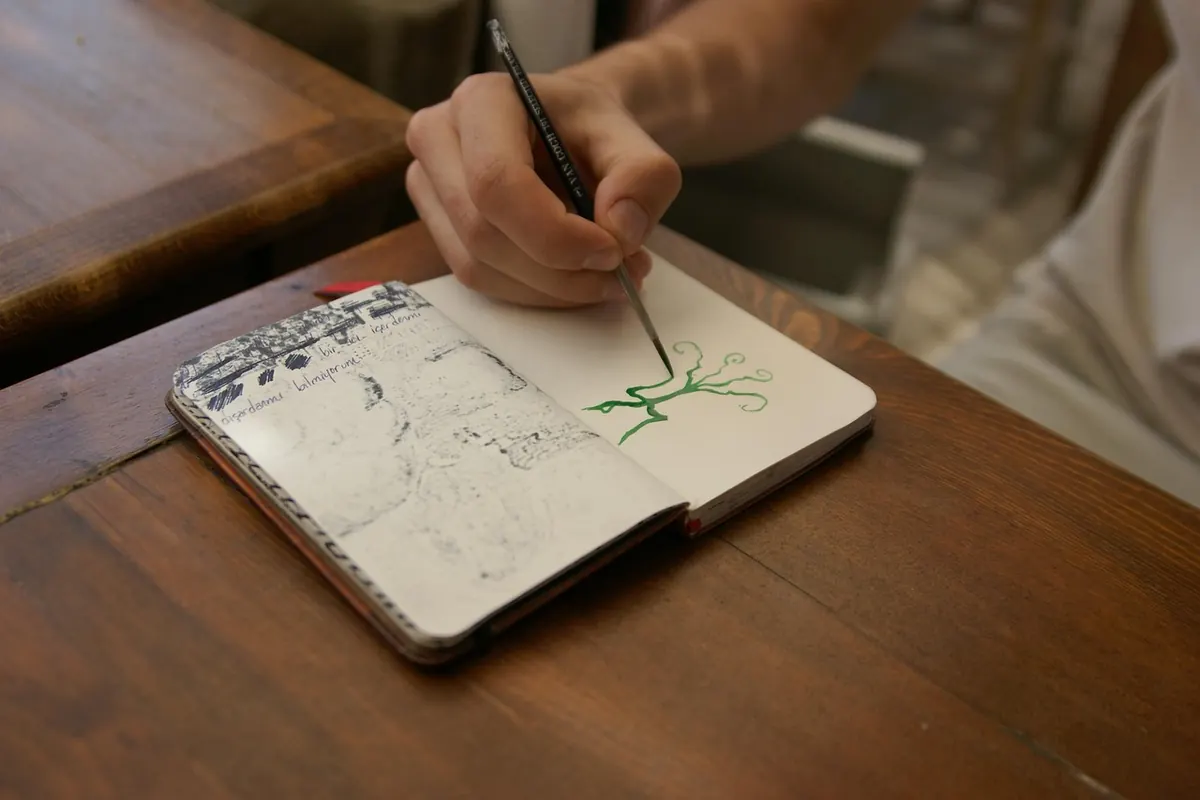
Drawing in a nature journal is not an art test. Its purpose is to slow your eyes down enough to notice structure. If the line goes wrong, the entry can still work: measure instead of outline. How many petals? Are the leaves opposite or alternating? Is the beak longer than the head? Does the stem carry hairs on one side only?
Practical moves that help:
- Draw small. A subject the size of a postage stamp is easier to finish and easier to compare with the next one.
- Add detail boxes: a single leaf, an eye, a seed head, drawn large in the corner.
- Write measurements and counts beside the drawing. Numbers are notes, not failures.
- Try a one-minute blind contour — eyes on the subject, not the page. The result is usually ugly and remarkably informative.
- Sketch an unfamiliar plant even if you cannot name it, then describe it in words: square stem, minty smell, growing in gravel.
Identification is optional. Attention is not.
Leaving Out Weather, Sound and Your Own Mood
A page full of names is oddly forgettable. What you reread in two years is the other material: that it was cold enough to write with gloves on, that the blackbird sang from the gutter above your head, that you were tired and nearly stayed home.
Add three sensory lines to every entry, no more. One thing you heard. One thing you felt — temperature, wind, damp, the grit of the path. One thing you smelled or tasted. Then a single sentence about yourself: what you were thinking, why you stopped, what you almost missed.
Those lines take ninety seconds, and they are what turns a species list into a diary. They also give your later self something to recognise, which is the whole point of keeping the thing.
Letting the Journal Become a Performance
There is a quiet pressure that arrives once the pages start looking decent: the urge to photograph them, post them, and measure them against the immaculate illustrated journals that fill the internet. That comparison is fatal in a small way. It shifts the audience from you to strangers, and the notebook begins to be made for showing rather than for looking.
Two habits help. Keep the first thirty entries completely private — no photographs, no sharing. And notice when you are shopping instead of journaling: another pen, another watercolour set, another beautiful book. Supplies are a pleasant substitute for practice, and they never teach you anything about the tree.
Paper or screen matters less than choosing one and stopping the collection of apps. What matters is that the journal stays a place where you are allowed to be approximate.
A Few Habits That Keep It Going
None of this needs discipline so much as a slightly kinder shape for the habit. A short list to start with:
- Keep the notebook where your hands already go: coat pocket, bag, kitchen table.
- Date and place first, always. One line.
- One subject per entry, fifteen minutes, palm-sized sketch.
- The same spot, the same time, once a week.
- Write in pen and leave the mistakes visible.
- If you miss a week, skip it. Do not catch up. There is nothing to catch up on.
Once a month, read back through three or four pages with a cup of tea. You are not looking for progress; you are looking for what you would otherwise have forgotten. That is the whole return on the practice — a season kept in your own handwriting, weather and all.
Photo: cemcev / Pixabay